Field report · 22 October 2026
Recursive Flint: 27B-class code and agents at 2.5B active — once its thinking goes back in.
Recursive's Flint (40B total, about 2.5B active, trained from scratch, released 21 October) went through our full quality suite at full precision, our qualification pipeline on one RTX PRO 6000, and a speed test on all seven of our GPU types. One early result looked like a weakness of the model and turned out to be our test harness; a controlled re-run of both Flint and Qwen3.8-27B settled it.
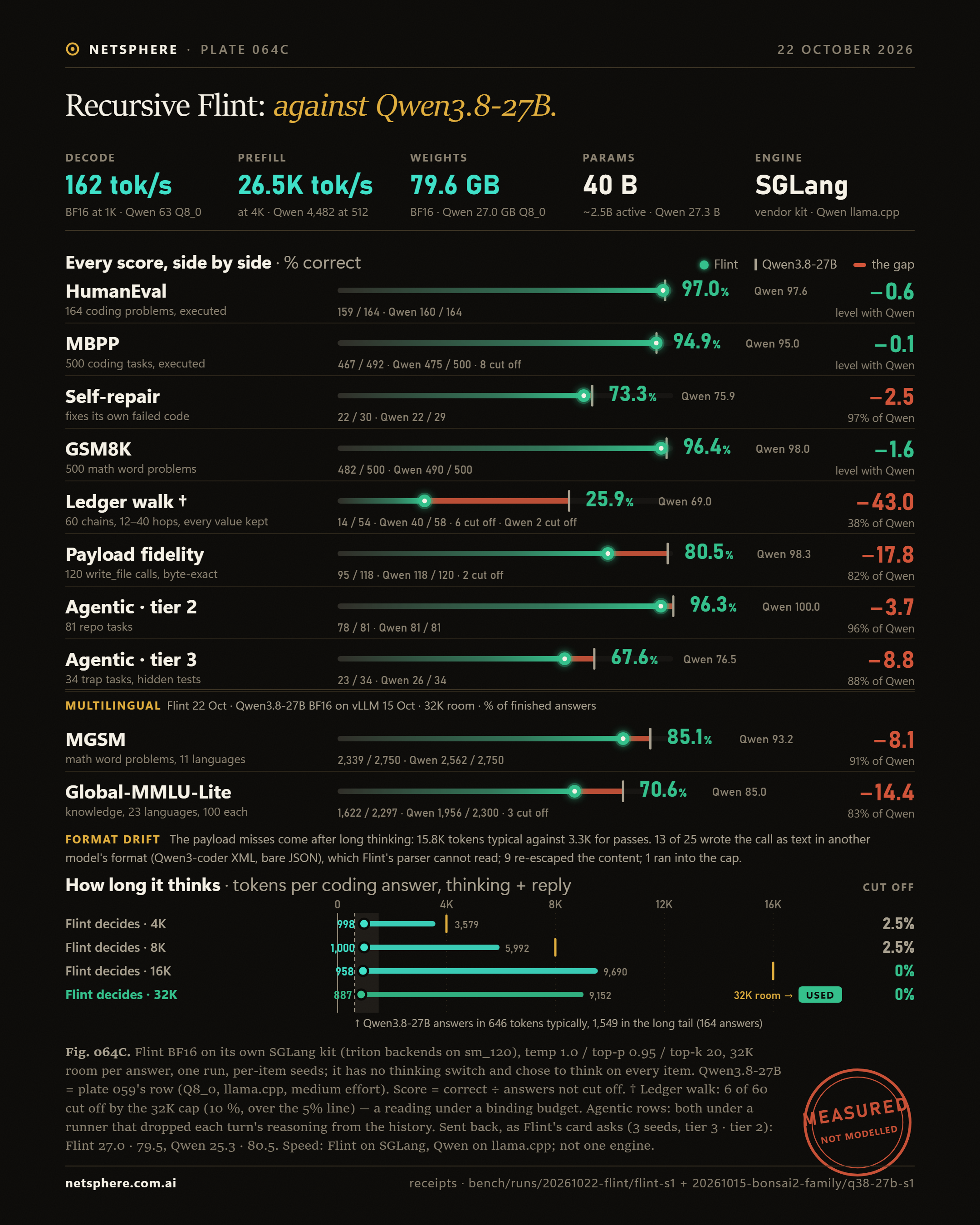
- Code and math at the Qwen3.8-27B level: HumanEval 159 vs 160, MBPP 467 vs 475, GSM8K 482 vs 490 — from 2.5B active parameters.
- Agentic work is level with Qwen3.8-27B — if the client sends Flint's reasoning back. Our harness stripped it; Flint then stopped thinking on later turns, could not tell it was done, and looped until cut off on 54% of hard tasks. Sent back, as its model card asks: 27.0 of 34 hard tasks against Qwen's 25.3–26.3. Qwen does not depend on this; Flint does.
- Weak on long state and exact copying: the ledger walk 14 of 60 (Qwen 40), byte-exact tool-call payloads 95 of 120 (Qwen 118) — after very long thinking it writes tool calls in other models' formats.
- English-first: MGSM 85.1% and Global-MMLU-Lite 70.6% against 93.2% and 85.0%; Burmese, Tajik and Yoruba under 50%.
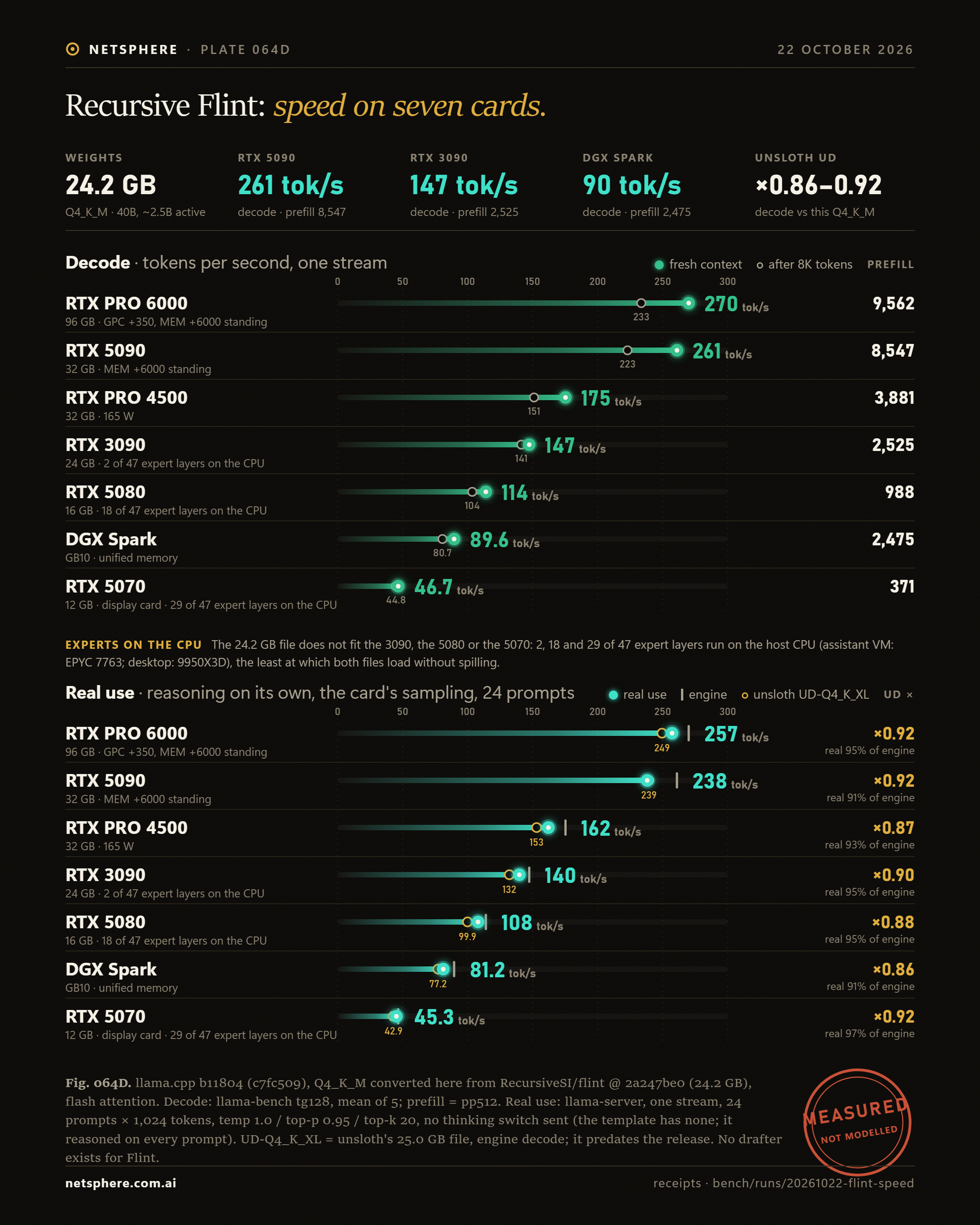
- Fast where it fits: 270 tok/s on an RTX PRO 6000 and 261 on an RTX 5090 (llama.cpp, Q4_K_M, 24.2 GB). At full precision on one RTX PRO 6000 (SGLang): 162 tok/s at 1K of context, 50 at 120K.
- It runs on workstation Blackwell without the vendor's support: the official SGLang kit is validated only on B300 and H200; with triton backends it serves correctly on the RTX PRO 6000.
1What we ran
- Model:
RecursiveSI/flint@2a247be0, Apache-2.0, 79.6 GB in BF16. 49 layers (2 dense + 47 mixture-of-experts, 256 experts with 6 active per token plus a shared expert), 35 sliding-window (513-token) and 14 full-attention layers, 262,144-token context. Text only. No thinking switch: the model decides each turn whether to reason — here it chose to on every single item. - Quality engine: Recursive's own SGLang kit (SGLang 0.5.16 +
flint_sglang0.1.4), built locally. Its two validated attention backends (FA4, FA3) are tied to B300 and H200 silicon, so we ran triton attention and triton MoE — a configuration Recursive does not validate. The BF16 weights take 74 GB of a 96 GB card. Four one-card copies. - Setting: the model's own sampling (temperature 1.0, top-p 0.95, top-k 20), 32K tokens of room per answer, per-item seeds, one run. Pre-registered before the first scored request.
- Tests: HumanEval 164 and MBPP 500 (executed, with two rounds of self-repair), GSM8K 500, the ledger walk (60 chains of 12–40 hops through 8K–32K-token logs, every running value kept), payload fidelity (120 tool calls whose content must match a hostile text byte for byte), agentic tier 2 (81 repository tasks) and tier 3 (34 held-out trap tasks, scored by hidden tests), MGSM (11 languages) and Global-MMLU-Lite (23 languages × 100). Then the qualification pipeline: speed by context depth, concurrency, needle retrieval to 120K, tool-call checks.
- Reference: Qwen3.8-27B from an earlier run of ours (Q8_0 on llama.cpp, medium effort, presence penalty 1.0) — a different engine and sampling, so context rather than a controlled pair. The agentic comparison in section 3 is controlled.
- Speed: llama.cpp b11804 (the first release that loads Flint) on seven GPU types, with a Q4_K_M we converted ourselves from the released weights. The community GGUFs were made the day before the release and are labelled "Flint Preview".
2Quality against Qwen3.8-27B
| Test | Flint (BF16) | Qwen3.8-27B | Note |
|---|---|---|---|
| HumanEval (164) | 159 | 160 | level |
| MBPP (500) | 467 | 475 | 8 cut off at 32K; level on finished answers (94.9 vs 95.0%) |
| GSM8K (500) | 482 | 490 | −8 |
| Self-repair | 22 of 30 | 22 of 29 | level |
| Ledger, walks fully right (60) | 14 | 40 | 6 cut off at 32K: limited by room |
| Payload, byte-exact (120) | 95 | 118 | format drift — section 4 |
| Agentic tier 3 (34) | 23 | 26 | first run; see section 3 |
| Agentic tier 2 (81) | 78 | 81 | first run; see section 3 |
| MGSM, % (11 languages) | 85.1 | 93.2 | English 97.6; Telugu 64.4, Swahili 68.8 |
| Global-MMLU-Lite, % (23) | 70.6 | 85.0 | English 90; Burmese 42, Tajik 44, Yoruba 49 |
Counts over all items (a reply cut off at 32K counts as wrong), except the multilingual rows, which are % of finished answers. Flint reasoned on 100% of items in every set. A 40-item probe found code and math clean at every answer cap from 4K; the ledger still cuts off 5 of 40 at 32K — Recursive recommends at least 32K and evaluated with up to 81,920.
Pros
- Matches a dense 27B on code (HumanEval, MBPP, self-repair) from about 2.5B active.
- Agentic tier 3 level with Qwen3.8-27B when its reasoning is sent back.
- Zero unparsable tool calls in 9,175 agentic tool calls; 43 of 44 tool-call checks clean.
- Plain and multi-hop retrieval perfect to 120K tokens.
- Apache-2.0; serves on stock SGLang 0.5.16 with its plugin, and on mainline llama.cpp.
Cons
- Weak at carrying state through long documents (ledger 14 vs 40), and runs out of 32K room there.
- Exact tool-call payloads break after long thinking (95 vs 118 of 120).
- Multilingual well behind (−8 MGSM, −14 Global-MMLU), worst on low-resource languages.
- Needs its reasoning sent back in multi-turn use, or it loops.
- Thinks at length: 2–3× the tokens of Qwen per agentic task.
- No thinking switch, no drafter model, no vLLM support yet.
3Agentic work, and the reasoning it needs back
In the first run, Flint scored 23 of 34 on the hard tier against Qwen's 26 — and ended 17 of its 34 tasks at the 25-turn limit: after fixing the bug and writing "All tests pass", it kept calling run_tests about 20 more times with empty replies. Its turns after the first carried almost no reasoning.
The cause was our harness. It sent each assistant turn back as text and tool calls and dropped the reasoning_content field. Flint's model card says to keep it; its chat template writes it back into every earlier turn; Recursive's own client sends the whole reply back. Without it, Flint sees a history in which it never thought before acting — and stops thinking, and stops recognising when it is done.
We added an option to send the reasoning back (requests are byte-identical without it), checked that it reaches the chat template, pre-registered the comparison, and ran both models both ways on the same seeds — the hard tier three times, the repository tier twice:
| Mean per seed (hard tier of 34 · repo tier of 81) | Reasoning dropped | Reasoning sent back |
|---|---|---|
| Flint | 23.7 · 76.0 | 27.0 · 79.5 |
| Qwen3.8-27B | 26.3 · 81.0 | 25.3 · 80.5 |
| Hard tier, pooled over 3 seeds | Flint dropped | Flint sent back | Qwen dropped | Qwen sent back |
|---|---|---|---|---|
| Tasks ended at the turn limit | 54% | 14% | 0% | 0% |
| Later turns that reason | 24% | 52% | 100% | 100% |
| Median tool calls per task | 26 | 11 | 7 | 7 |
| Passed (of 102) | 71 | 81 | 79 | 76 |
| Tokens per task (median) | 1,334 | 2,641 | 930 | 1,121 |
- For Flint it is decisive. Every seed with the reasoning sent back beats every seed without it, on both tiers; four tasks flip to passing in most seeds and none flip the other way. A residual 14% still end at the limit re-running tests after a fix — Flint's own tendency, now at a much lower rate.
- Qwen does not depend on it. Its prompt opens a fresh thinking block every turn, so it re-thinks whatever the history holds; its scores move only inside its own seed-to-seed spread. Our first Qwen seed reproduced its earlier result exactly (26 and 81).
- Like for like, Flint is level with Qwen3.8-27B on the hard tier and 2–3 tasks behind on the repository tier — and it spends 2–3× the tokens per task to get there (median 2,641 against 930–1,121).
- With the reasoning sent back, 20 of Flint's 21 hard-tier misses over three seeds are the closed-book traps (tasks that need knowledge outside the repository); Qwen's are 42 of 49. In the first run Flint's other misses included a shallow-copy fix that left a nested list shared, and two "summary written and verified" claims with no file at the required path.
reasoning_content back on every assistant turn, exactly as Recursive's card says. Most agent frameworks drop it by default because most models don't need it. This one does.4Payload fidelity: format drift after long thinking
The payload test asks for one write_file call whose content must match a 300–800-character text full of quotes, backslashes and Unicode, byte for byte. Flint passed 95 of 120. Its failing replies ran a median 15,800 tokens of thinking and reply against 3,300 for passes — on a copy task — and then:
- 13 wrote the call as plain text in another model's format, which Flint's parser cannot read: Qwen3-coder
<function=…>XML (6), bare JSON with a name (3), afunction_callsJSON list (2), a ReAct "Thought / Action" block and a JSON code block (2). - 11 made a proper call with the wrong content: 9 escaped it a second time (a literal
\nwhere the file needs a newline), 2 were off by one character. - 1 was a native call cut off by the 32K limit.
The prompt names no format, and the vendor's tool grammar allows free text before a call, so it cannot prevent this. Scored as served, per the pre-registration.
5Speed on seven cards
| Card | Experts on CPU | Decode | After 8K | Prefill | Real use | unsloth UD-Q4_K_XL |
|---|---|---|---|---|---|---|
| RTX PRO 6000 | – | 270.0 | 233.5 | 9,562 | 257.2 | 249.4 |
| RTX 5090 | – | 260.9 | 223.0 | 8,547 | 238.1 | 239.4 |
| RTX PRO 4500 | – | 175.3 | 151.1 | 3,881 | 162.1 | 153.0 |
| RTX 3090 | 2 of 47 layers | 147.4 | 141.3 | 2,525 | 139.8 | 132.1 |
| RTX 5080 | 18 of 47 | 114.0 | 103.6 | 988 | 108.0 | 99.9 |
| DGX Spark (GB10) | – | 89.6 | 80.7 | 2,475 | 81.2 | 77.2 |
| RTX 5070 | 29 of 47 | 46.7 | 44.8 | 371 | 45.3 | 42.9 |
Tokens per second, one stream. Decode = llama-bench tg128 (mean of 5) on our Q4_K_M (24.2 GB); prefill = pp512; real use = llama-server, 24 prompts × 1,024 tokens at the card's sampling. The RTX PRO 6000 runs our standing overclock (GPC +350, MEM +6000) and the 5090 MEM +6000; the 5070 is a desktop display card with the screen on. Peak temperature 39–48 °C on discrete cards, 71 °C on the Spark.
- Our self-converted Q4_K_M decodes 8–16% faster than unsloth's UD-Q4_K_XL on every card, and is 0.9 GB smaller. (The quality of either file was not measured.)
- Real use runs at 91–97% of the engine figure; 8K of context costs 4–15% of decode.
- Against MiniCPM-V 4.7 35B-A3B on the same harness, Flint is slower on cards that hold it whole (270 vs 367 tok/s on the RTX PRO 6000) despite fewer active parameters — 49 layers, a 150K-token output head and one-day-old llama.cpp support — and level or ahead where experts run on the CPU (5080, Spark, 5070).
- Fitting a card that cannot hold it: at the same split the smaller Q4_K_M needs more GPU memory than unsloth's larger file. A fit tested on one file ran the 5080 out of memory and, on Windows, spilled into shared memory and decoded at 2.7 tok/s. Those runs were thrown out; the fits shown hold for both files.
6One RTX PRO 6000 at BF16: depth, load, retrieval, tool calls
The qualification pipeline ran on one RTX PRO 6000 with the SGLang kit, its memory pools shaped so a full 262K-token request fits (316,686 full-attention tokens). It passes.
| Context | 1K | 4K | 8K | 32K | 64K | 120K |
|---|---|---|---|---|---|---|
| Decode, tok/s | 162.3 | 153.7 | 143.6 | 103.0 | 74.4 | 50.2 |
| Prefill, tok/s | 12,865 | 26,455 | 25,132 | 17,777 | 12,412 | 6,768 |
| Time to first token | 0.08 s | 0.15 s | 0.32 s | 1.8 s | 5.2 s | 17.7 s |
- Concurrency: total throughput climbs to about 750 tok/s at 32–40 parallel streams (633 at 24, 713 at 32, 752 at 40), then collapses past 40 (249 at 48, about 180 at 56–64): the sliding-window memory pool fills and the server starts evicting and recomputing requests. That is the pool shape we chose to fit full-length context, not the model's ceiling — more streams need a larger sliding-window share.
- Retrieval to 120K: a single planted fact and three-hop lookups are perfect at every depth (30/30, 18/18); summing scattered facts nearly so (17/18). Decoy-dense search, recalling many facts at once and following a decoyed chain fail from 16–32K (9/18, 7/18, 2/18; 3 tries per cell).
- Tool calls: 43 of 44 checks clean on schema, tool choice, arguments and no hallucination. The one miss: asked to migrate a VM with no migration tool available, Flint kept calling tools instead of saying it could not.
7What to run
- Coding agents: yes — Flint's strength. Always send
reasoning_contentback on every assistant turn; without it, expect loops and about 10 fewer hard tasks solved per 102 (71 vs 81). Give it at least 32K tokens per turn. - Engine: on an RTX PRO 6000, Recursive's SGLang kit with
--attention-backend triton --moe-runner-backend triton— one card holds BF16 with room for a full-length request. Keep under about 40 parallel streams at the full-context pool shape, or give the sliding-window pool more room for many short requests. - Single user, local: llama.cpp b11804 or later with a Q4_K_M converted from the released weights — 270 tok/s on an RTX PRO 6000, 261 on a 5090, 175 on an RTX PRO 4500; it fits whole on 32 GB cards.
- Guard exact writes: verify file contents written through tool calls, especially long verbatim payloads.
- Not for: long state-tracking through big documents, or work outside English — Qwen3.8-27B is clearly stronger there.
8Caveats
- One run per cell for the quality suite (sampled decoding); the agentic comparison used 3 + 2 paired seeds per arm. Seeds of one arm span 2–4 hard-tier tasks.
- Flint picks its own thinking per turn; the Qwen rows ran with thinking fixed on at medium effort. Rows other than section 3's agentic comparison are context, not a controlled pair (different engine, sampling and precision).
- The triton serving path on the RTX PRO 6000 is not a configuration Recursive validates. Outputs checked correct; one greedy (temperature 0) answer at 120K was right but trailed off into junk — greedy decoding is also listed as unvalidated by the vendor.
- Our concurrency instrument measures throughput over the window from the first token to the last. At 40 streams, two of three repeats read double (1,636 and 1,610 vs 771 tok/s) with the same wall time and tokens, because the server prefilled every request before decoding any. The figures above are read by wall time.
- Our tool-call check also drops reasoning between turns; its one miss may share the cause.
- Not measured: the quality of quantized files (19 community quants exist), vLLM (support is still a pull request), Recursive's own headline benchmarks (Terminal-Bench 2.1 54.9, SWE-bench Verified 74.2), and anything multimodal (Flint is text-only).
Every figure on this page was re-derived from the raw rows of runs made on 22 October 2026 on our own machines. Run directories: bench/runs/20261022-flint (quality suite, pre-registration and its two amendments, the agentic re-runs), bench/runs/20261022-flint-speed (seven cards), bench/runs/20261022-flint-qual (qualification). The rows are kept; to see them, or to send a model you want measured, write to hello@netsphere.com.ai. How we measure: Method.