Explainer · 26 October 2026
Gen5 vs Gen4 NVMe: faster loads and prefill, not faster decode.
One drive, one variable. The model drive in our 4-GPU server, a Kingston DC3000ME 7.68 TB, read at Gen5 x4, then with its link capped to Gen4 x4 at the root port, then restored. We timed cold model loads on three engines, served with the weights resident, and ran DeepSeek V4.1-Flash with its Engram tables read from the drive instead of RAM, from one stream to 64.
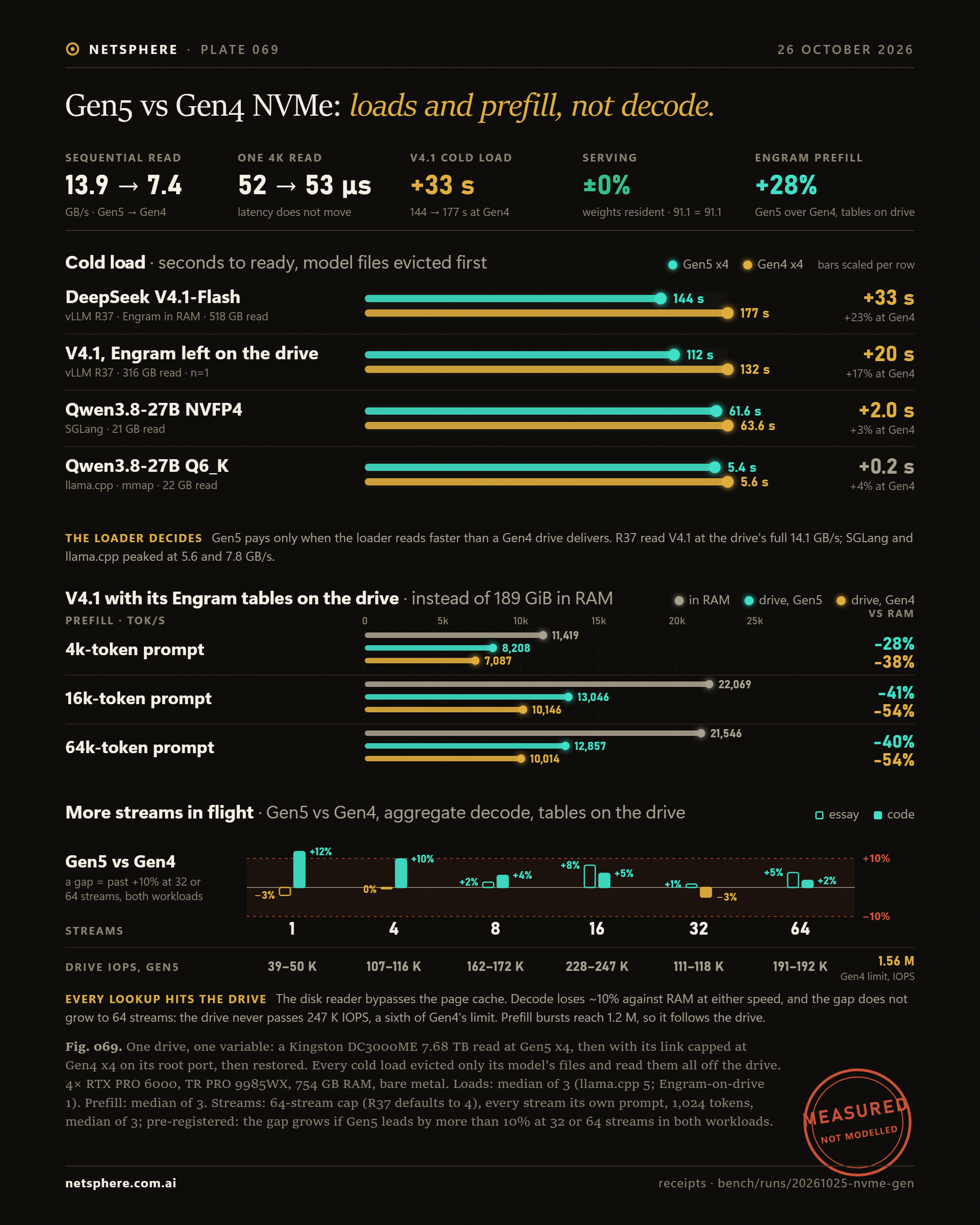
- The drive halves, its latency does not move. Sequential reads drop from 13.9 to 7.4 GB/s at Gen4 and 256-deep random reads from 2.26 M to 1.56 M IOPS; one 4K read takes 52 µs at Gen5 and 53 µs at Gen4.
- Loads: Gen5 pays only when the loader can outrun Gen4. vLLM's
instanttensorloader reads DeepSeek V4.1-Flash's 518 GB at 14 GB/s: ready in 144 s at Gen5, 177 s at Gen4. SGLang and llama.cpp loading a 27B model read below Gen4's ceiling and lose 2.0 s and 0.2 s. - The loader matters more than the drive. The same model through the
safetensorsloader took 438 s at Gen5. - Serving with the weights resident: no change. 91.07 tok/s at both speeds, with the link flipped live under the same running server.
- Engram tables on the drive cost about 10% of decode at either speed. At 16k–64k tokens, prefill loses 40% at Gen5 and 54% at Gen4 against RAM; Gen5 prefills 28% faster than Gen4.
- More streams do not open a gap. Up to 64 streams, Gen5 stays within −3% to +5% of Gen4 at 32 and 64. The drive never passes 247 K IOPS, a sixth of what it sustains at Gen4.
1The drive
| Read (fio, O_DIRECT, io_uring) | Gen5 x4 | Gen4 x4 | Change | 4× Micron 7450, RAID0, Gen4 |
|---|---|---|---|---|
| Sequential, 1 MiB | 13.9 GB/s | 7.4 GB/s | −47% | 14.8 GB/s |
| Random 4K, 256 in flight | 2.26 M IOPS | 1.56 M IOPS | −31% | 2.28 M IOPS |
| Random 4K, one at a time (p50 / p99) | 52 / 64 µs | 53 / 65 µs | none | 63 / 75 µs |
Medians of 3. The cap sets the root port's target link speed and retrains the link: same drive, same slot, same data. One Gen5 drive reads about as fast as four Gen4 drives striped on this board.
2Cold model loads
| Model, engine | Gen5, ready | Gen4, ready | Gen4 costs | Read off the drive |
|---|---|---|---|---|
DeepSeek V4.1-Flash, vLLM, TP4, instanttensor | 143.9 s | 176.5 s | +33 s (+23%) | 518 GB at 13–14 GB/s vs 7.1–7.4 |
| same, Engram tables left on the drive | 112.3 s | 131.8 s | +20 s (+17%) | 316 GB |
same, safetensors loader | 437.5 s | — | — | 510 GB at 1.5 GB/s: the loader's limit |
| Qwen3.8-27B NVFP4, SGLang, TP1 | 61.6 s | 63.6 s | +2.0 s (+3%) | 21 GB, peak 5.5 vs 4.7 GB/s |
| Qwen3.8-27B Q6_K, llama.cpp, mmap | 5.4 s | 5.6 s | +0.2 s (+4%) | 22 GB, peak 7.8 vs 7.2 GB/s |
Before every load, that model's files were evicted from the page cache and the eviction verified, so every load read the whole model off the drive. Median of 3; llama.cpp median of 5 with readiness polled every 0.2 s; Engram-on-drive n=1.
The weights phase of the V4.1 load is where the link shows: 39.3 s at Gen5, 70.6 s at Gen4. The rest of the time to ready is the same at both speeds: about 105 s of engine start-up after the weights are in. A load from a warm page cache never touches the drive at all, and with 754 GB of RAM most reloads on this server come from RAM.
3Serving with the weights resident
| Run | Gen5 | Gen4 |
|---|---|---|
| Qwen3.8-27B, SGLang decode, link flipped live under the same server | 91.07 tok/s | 91.07 tok/s |
| V4.1-Flash decode, Engram in RAM: Sieve / novel code / essay | 452 / 321 / 248 | 476 / 312 / 251 |
| V4.1-Flash prefill, Engram in RAM: 4k / 16k / 64k tokens | 11.4k / 22.1k / 21.5k | 11.6k / 22.1k / 21.5k |
No drive reads during any of these runs. The V4.1 decode differences are run-to-run spread from speculative decoding (Sieve alone ranged 438–483 tok/s at Gen5), not the link.
4DeepSeek V4.1-Flash with its Engram tables on the drive
V4.1-Flash carries Engram lookup tables: 203 GB of files that, served from RAM, pin 189 GiB of host memory. The community vLLM
image we serve it with (localinferencelab/vllm, release R37) can instead read table rows straight off the drive with
io_uring, bypassing the page cache. That is the mode for a machine without the RAM to spare, and the one place where the drive is
read during inference.
| V4.1-Flash, Engram tables… | in RAM | on the drive, Gen5 | on the drive, Gen4 |
|---|---|---|---|
| Cold load: read / weights / ready | 518 GB / 39 s / 144 s | 316 GB / 24 s / 112 s | 316 GB / 43 s / 132 s |
| Decode, one stream: Sieve / novel code / essay (tok/s) | 452 / 321 / 248 | 416 / 288 / 219 | 397 / 287 / 221 |
| Prefill, 4k / 16k / 64k tokens (tok/s) | 11.4k / 22.1k / 21.5k | 8.2k / 13.0k / 12.9k | 7.1k / 10.1k / 10.0k |
| Read off the drive during the bench | 0 GB | 148 GB, bursts to 1.16 M IOPS | 147 GB |
| Host RAM for the tables | 189 GiB pinned | none | none |
Decode: median of 5, speculative decoding on. Prefill: median of 3. The table files were evicted before each bench and stayed at 0 bytes resident afterwards: every lookup went to the drive.
- Decode loses about 10% against RAM, and the link speed is inside the noise. One decode step waits on a batch of reads, so it is set by single-read latency, which Gen4 does not change.
- Prefill follows the drive. A 4,096-token chunk fires lookups for every token at once, in bursts up to 1.16 M IOPS against Gen4's 1.56 M ceiling. That is where the parallel read rate shows: Gen5 prefills 28% faster than Gen4 at 16k–64k.
- Disk mode loads faster, because it skips the 203 GB of table files, and frees 189 GiB of host RAM.
- Trap: Docker's default seccomp profile blocks io_uring, and the disk-mode server then fails at start-up. We ran
that one container under Docker's own default profile plus
io_uring_setup,io_uring_enterandio_uring_register, nothing else.
5More streams in flight
One stream mostly exposes lookup latency. With more streams decoding at once, more lookups are in flight, so the Gen5 lead could grow. Before the first request we wrote down what would count: Gen5 more than 10% ahead at 32 or 64 streams, in both workloads.
| Streams | Essay: RAM / Gen5 / Gen4 | Gen5 vs Gen4 | Code: RAM / Gen5 / Gen4 | Gen5 vs Gen4 | Drive IOPS, Gen5 |
|---|---|---|---|---|---|
| 1 | 221 / 208 / 214 | −3% | 304 / 303 / 270 | +12% | 39–50 K |
| 4 | 406 / 366 / 368 | 0% | 635 / 609 / 555 | +10% | 107–116 K |
| 8 | 595 / 552 / 542 | +2% | 871 / 846 / 813 | +4% | 162–172 K |
| 16 | 928 / 835 / 776 | +8% | 1,365 / 1,185 / 1,130 | +5% | 228–247 K |
| 32 | 425 / 400 / 395 | +1% | 712 / 624 / 646 | −3% | 111–118 K |
| 64 | 775 / 712 / 678 | +5% | 1,298 / 1,111 / 1,085 | +2% | 191–192 K |
Aggregate decode, tok/s, median of 3. Every stream its own prompt, temperature 0, 1,024 tokens, no stream errors in
2,250 streams. R37 serves 4 streams at once by default (MAX_NUM_SEQS=4); every arm here ran with 64.
- The gap does not grow. At 32 and 64 streams Gen5 leads by −3% to +5%, inside the spread of the reps. The +12% for code at one stream is speculative-decoding variance: the one-stream bench above measured novel code at 288 vs 287.
- The drive is never the limit in decode. The busiest level read about 250 K IOPS, roughly 1 GB/s of 4 KB reads: a sixth of what the drive sustains at Gen4 and a ninth of Gen5.
- Against RAM, the drive costs 6–17% at 16–64 streams, more than at 1–8 streams (0–11%).
- Every arm, RAM included, dips at 32 streams and recovers at 64 (essay in RAM: 928, 425, 775). That is the engine, not storage; we did not chase it here.
6What it means
- Buying a drive for a GPU server: Gen5 saves about 30 s per 500 GB cold load, if the engine's loader reads faster than 7 GB/s. With plenty of RAM, most reloads come from the page cache and the drive never shows.
- Serving with weights resident: the drive generation does not matter.
- Engram from storage, on a machine without the RAM for the tables: Gen5 buys back about a quarter of the prefill penalty and none of the decode one. RAM is still the fast path.
- Not measured: a different Gen5 drive model, drives behind a PCIe switch, or Windows.
Ours: bench/runs/20261025-nvme-gen (fio JSON per rep, I/O samples and engine logs per load, eviction records,
the Engram benches, and the written pre-registration for the stream test) and the kit in bench/nvme-gen, 25–26 October 2026.
To see the rows, write to hello@netsphere.com.ai.